


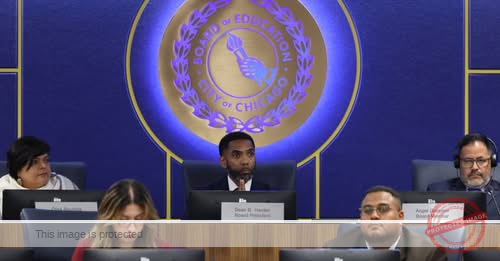
A tense silence hung over the Chicago Board of Education on Thursday night as the roll call vote began.
Just hours earlier, community members had packed the room, urging the board to pass a 2025-26 budget that spared classrooms from cuts.
At the heart of the debate was a $200 million high-interest loan and a disputed pension payment for nonteaching CPS staff members — both backed by Mayor Brandon Johnson, both left out of the district’s proposal.
As Johnson-appointed board members Ed Bannon, District 1A, Anusha Thotakura, District 6A, and Cydney Wallace, District 8B, quietly broke ranks, gasps rippled through the crowded room. The final tally — 12 in favor, seven opposed, and one abstention — drew cheers.
The vote marked a public setback for Johnson, a former Chicago Teachers Union organizer navigating the shift from movement politics to municipal governance. It also exposed the political fragility of the city’s hybrid school board — long championed by progressives as a vehicle for equity, now emerging as a challenge to Johnson’s authority.
“We have this unrealistic expectation that we’ll always agree. And that’s not how democracy works,” said Bannon in an interview with the Tribune on Friday.
The vote marked a public setback for Johnson, a former Chicago Teachers Union organizer navigating the shift from movement politics to municipal governance. It also exposed the political fragility of the city’s hybrid school board — long championed by progressives as a vehicle for equity, now emerging as a challenge to Johnson’s authority.
“We have this unrealistic expectation that we’ll always agree. And that’s not how democracy works,” said Bannon in an interview with the Tribune on Friday.
But Johnson’s yearlong struggle to secure board support for a controversial borrowing plan, aimed at avoiding classroom cuts and funding a pension payment for nonteaching CPS workers, has exposed deepening divisions between his administration, former allies and a hybrid board he largely appointed himself.
At a South Side town hall earlier this week, Johnson suggested his plan was being held to a different standard.
“Did you know that (former CPS CEO) Forrest Claypool and Rahm Emanuel borrowed … and you’re talking about a $200 million possible loan?” Johnson asked. “These individuals were reckless. Let’s call it like it is. When you put a Black man in charge of the city, all of a sudden everybody wants to be an accountant.”
But for many progressive allies, this fight comes down to balance sheets.
Between 2016 and 2018, the district undertook several rounds of “crisis borrowing” to cover current expenses and settle outstanding debts, practices that are frowned upon by financial experts. The district still owes billions, according to a CPS memo issued last summer. Debts from those two years of borrowing alone cost the district nearly $200 million that year, according to the memo, with $2.1 billion still left to pay.
Debby Pope, a veteran teacher and a board member representing District 2B, abstained from Thursday’s vote. She described CPS as operating under a “budget of scarcity,” forced into zero-sum decisions that pit basic services against one another.
