


Olena Konovaliuk of Chicago fears she might never again see her family in the Donbas region of eastern Ukraine, where she was born and raised, as Russian President Vladimir Putin demands the land be relinquished to Moscow during ongoing U.S.-led peace talks.
Giving up Donbas — or any portion of the war-torn nation — is unfathomable to Konovaliuk and many other locals of Ukrainian descent, who insist their entire homeland must be sovereign without exception or partial surrender.
“This sounds threatening to me because my family is still there. It is like saying, ‘Please take off your arm and give it to us,’” she said. “I know that there are people … in the eastern region that are still fighting. They still have a pro-Ukrainian mindset and they don’t want that connection to Russia.”
The 31-year-old mother of two fled her hometown of Luhansk in the Donbas region in 2014 when Russian-backed forces illegally seized control of the area, a precursor to the full-scale war that began in February 2022 and rages on today.
“Some of my relatives didn’t survive, unfortunately,” she said, referring to both Russian invasions of Ukraine.
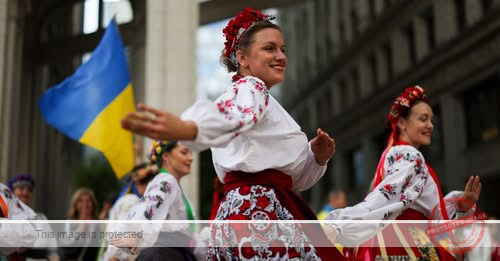
Konovaliuk and hundreds of other Ukrainian Americans recently celebrated the 34th anniversary of their ancestral nation’s independence with a march and rally in downtown Chicago. The event was late last month held amid continuing U.S.-forged efforts to mediate a peace settlement as the war continues in its fourth year.
Just a few days prior to the celebration, Putin had made stiff demands to end the bloodshed: Ukraine must abandon its ambitions to join NATO, no western troops can be on its land and the Donbas region must be ceded to Moscow, according to Reuters.
But local demonstrators staunchly opposed all of these stipulations, chanting in unison along Michigan Avenue during the anniversary celebration: “Ukraine belongs in NATO. Donbas is Ukraine. Free us all.”
“We know in our mind we cannot accept that. We’ve paid such a high price for this land,” said Liliia Popovych of the Ukrainian Congress Committee of America Illinois Division, which organized the march. “We know our people are going to fight. We are never going to give up our independence. Freedom is the biggest value for us.”
Ukrainian President Volodymyr Zelenskyy has also publicly rejected the notion of yielding any of his country’s internationally-recognized land, whose borders were established Aug. 24, 1991, upon gaining independence from the Soviet Union.
“We will not leave Donbas. We cannot do this. Everyone forgets the first part: Our territories are illegally occupied,” Zelenskyy told reporters at a press briefing last month. “Donbas for the Russians is a springboard for a future new offensive.”
DePaul University political science professor Dick Farkas said it’s not even in Zelenskyy’s power to abdicate the Donbas region, a largely industrial area bordering Russia.
The constitution of Ukraine states that “the territory of Ukraine within its present border is indivisible and inviolable,” requiring an “all-Ukrainian referendum” to alter its boundaries.
The document also prohibits any leader from ceding Ukrainian land, Farkas said during a recent interview with the Tribune.
“I don’t think any political leader of any sort, Zelenskyy or anyone else, could accept this,” added the professor, who teaches courses on Russian politics, Putin and cyberwarfare. “It’s just not an option.”
Now American peace efforts there seem to have largely stalled.
After meeting with Putin in Alaska last month, Trump declared that peace in Ukraine was “attainable.”
Yet last week, he expressed aggravation with Putin as Russian strikes on Ukraine continued despite recent diplomatic efforts to end the war. While Trump raised the possibility of sanctioning Russia, he has yet to impose any economic consequences.
Then on Thursday, Russian missiles and drones rained on Kyiv, causing multiple deaths and injuries.
While Trump has said he’s trying to arrange direct talks between Putin and Zelenskyy, Russia’s top diplomat has indicated that Putin will refuse unless Kyiv agrees to some of his demands to end the conflict. Moscow also recently balked at proposals to establish post-war security assurances for Ukraine, which fears a future Russian invasion even if a peace agreement were attained.
