


There are days when Charles McKenzie wants to give up.
After his 1-month-old niece was shot in the head. Or when his friend was shot to death in the South Side neighborhood where they both grew up. Hours after celebrating his birthday earlier this summer, when he got the call that gunfire had killed someone else he considered family.
But he persists in hopes that one day, change will stick.
“I gotta keep running, keep running, keep running,” McKenzie said. “Until I can’t run no more.”
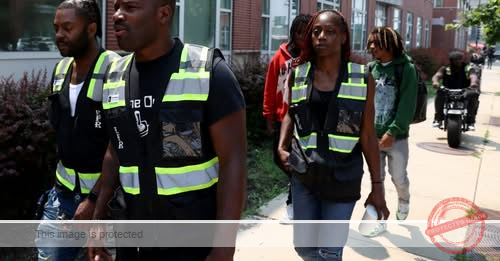
McKenzie, 36, is the founder of Englewood First Responders, a nonprofit organization primarily composed of at-risk youth and young adults that for six years now has worked to prevent and clamp down on violence in Englewood and other areas across the city — even as it faces the heartbreak of that violence head-on.
Since last summer, Englewood First Responders have had to mourn two of their own members who were killed by gunfire. But for those that remain, their work continues.
Despite insistence from the White House that Chicago is in need of a federal crime crackdown, efforts by both elected officials and people like McKenzie to prevent shootings and disrupt cycles of violence have been — and are — in force. The city is now well into its fourth consecutive year of declining violent crime. Through late August, Chicago had recorded 266 homicides in 2025, a 32% decline in killings from the same period in 2024, while total shooting incidents are down 36%.
That decline has been mirrored in the Chicago Police Department’s Englewood District, which also includes the Gage Park, Auburn Gresham, Chicago Lawn, Greater Grand Crossing and West Englewood neighborhoods. As of Aug. 24, the district had recorded 15 homicides, a drop of 50% from this time last year, according to Chicago police data. Shooting incidents in the district are down 34%.
From the same period four years ago, the decline is sharper, with homicides down 62% in the district from 2021 and shootings down 64%, police data shows.
McKenzie, in part, credits the change to Englewood First Responders, noting he and his team get calls “all through the night” these days to divert and de-escalate violence. But he’s intimately aware they have more to do. His grief alone is a daily reminder.
And as many strides as they’ve made, it’s the fear that he’ll “lose another one if I drop that ball” that has McKenzie staying the course.

The relationships that make violence interrupters’ work deeply felt is also what makes it effective, said Chico Tillmon, executive director of Community Violence Intervention Leadership Academy at the University of Chicago.
“It takes what we call relentless engagement,” Tillmon said. “It’s not going to happen in the first conversation. People have to know you really care about them, and it takes time and consistency.”
Last year, after five men working as peacekeepers were shot in separate shootings in the Little Village and North Lawndale neighborhoods — killing three — fellow outreach workers maintained that despite the risk, the anti-violence model is a long-term solution.
“People ask me, how do I cope with it?” McKenzie said. “I go out there and I continue to keep going … because if we stop, we let a lot of people down. So we have to be strong … and show that (there’s) people out here that (are) losing so many loved ones back to back, and they’re not giving up.”
A different path
Latanesha Thomas began working with Englewood First Responders when she was just 12 years old. Born and raised in Englewood, Thomas, now 17, said there’s no telling where she’d be if she wasn’t part of the nonprofit. It’s where she met her best friend, Meeyah Smith, or, as Thomas said, the “yin to my yang.”
Meeyah, 16, was shot and killed on the Fourth of July. She was at a large gathering with her family in Avalon Park when unknown assailants began shooting just before 11 p.m., according to a police report. Gunfire struck Meeyah in the throat and another victim, a 35-year-old man, in the leg, leaving four shell casings and three pools of blood, the report said. Meeyah was pronounced dead at Jackson Park Hospital & Medical Center. Her death was ruled a homicide by the Cook County medical examiner’s office.
Nearly two months later, there had been no arrests in connection to the shooting, according to Chicago police.
Thomas last saw Meeyah in person a few days before the shooting, though they texted each other every day in a group chat they shared with other friends from Englewood First Responders, including 17-year-old Jemya Hopkins, that she called “sisters.” Also introduced through Englewood First Responders, Hopkins said she and Meeyah “instantly clicked,” connecting over how alike they were, down to sharing the same astrological sign. (They were both Pisces, Hopkins said.)
Meeyah messaged in their sisters’ group chat the night she died, Hopkins said, who recalled “we were literally texting moments … before it happened.” They heard Meeyah had been shot and killed the next morning.
“My mind was everywhere,” Thomas said. “We literally had plans to go out (that) day. It’s like, we was just with you, how can you be gone so fast?”
Thomas rattled off adjectives to describe Meeyah: energetic, outgoing, smart, funny and genuine. She said Meeyah could walk into any room, or even a pitch-black tunnel, for that matter, and light up the space. She’ll miss Meeyah coming into Englewood First Responders’ headquarters at 838 W. Marquette Road “every single day yelling, ‘Bestie!’” she recalled.
Four days after the shooting, Thomas returned to work without her.
The 40 to 50 members of Englewood First Responders, who range in age from 11 to 38, focus their efforts on directly combating violence and general community outreach.
