


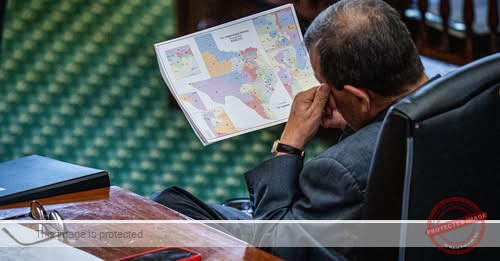
Washington — The Supreme Court on Thursday restored for now Texas’ newly redrawn congressional map that could give Republicans five additional House seats, after a lower court found that some of the new voting lines were racially discriminatory.
The high court appeared to split 6-3. It said in an unsigned order that it “has repeatedly emphasized that lower federal courts should ordinarily not alter the election rules on the eve of an election,” and the district court “violated that rule here.”
“The District Court improperly inserted itself into an active primary campaign, causing much confusion and upsetting the delicate federal-state balance in elections,” the Supreme Court said.
The court wrote that “based on our preliminary evaluation of this case,” Texas was likely to succeed on the merits of its arguments that the district court merits committed “at least two serious errors” when it found the new map to be an unconstitutional racial gerrymander.
Justice Elena Kagan, joined by Justices Sonia Sotomayor and Ketanji Brown Jackson, dissented from the ruling and said that the lower court had sought to determine whether Texas had accomplished “its partisan objectives by means of a racial gerrymander enacting an electoral map slanted toward Republicans” and found that Texas “largely divided its citizens along racial lines to create its new pro-Republican House map, in violation of the Constitution’s Fourteenth and Fifteenth Amendments.”
“The court issued a 160-page opinion recounting in detail its factual findings,” Kagan added. “Yet this Court reverses that judgment based on its perusal, over a holiday weekend, of a cold paper record.” Kagan was referring here to the Supreme Court’s emergency docket, also known as the shadow docket. The term refers to the orders and summary decisions issued by the Court without the full briefing and oral argument that accompanies cases on the regular docket.
“We are a higher court than the District Court, but we are not a better one when it comes to making such a fact-based decision,” Kagan said.
The decision from the high court is a boon to House Republicans and President Trump — who has pushed numerous GOP-led states to undertake a rare mid-decade redistricting in an effort to ensure his party holds onto its majority in the House.
That plan was temporarily derailed last month when a divided panel of three judges blocked Texas from using its re-crafted House map for the 2026 election cycle and found that certain districts were racially gerrymandered.
Texas Gov. Greg Abbott, a Republican, swiftly asked the Supreme Court to intervene, and Justice Samuel Alito temporarily reinstated the map while the full court considered the request. The high court has now agreed to block the lower court’s decision, allowing Texas to use the new district lines for next year’s House elections.
Abbott celebrated the high court’s decision in a statement, writing: “We won! Texas is officially—and legally—more red.”
“The new congressional districts better align our representation in Washington D.C. with the values of our state,” the governor said. “This is a victory for Texas voters, for common sense, and for the U.S. Constitution.”
Texas state House Democratic Leader Rep. Gene Wu said in a statement, “The Supreme Court failed Texas voters today, and they failed American democracy. This is what the end of the Voting Rights Act looks like: courts that won’t protect minority communities even when the evidence is staring them in the face.”
The move by Texas Republicans to draw new House district lines over the summer kicked off a redistricting fight that has extended to numerous other states. Mr. Trump and White House aides had been pushing GOP lawmakers in Texas to create a new map to bolster Republicans’ chances of maintaining their majority in the House, and Abbott called a special session to tackle the issue.
In the wake of that decision, California swiftly moved to redraw its congressional map to net up to five seats for Democrats, offseting the new GOP-leaning seats in Texas. GOP state lawmakers in North Carolina and Missouri have also approved plans that each seek to shift a single Democratic-held seat to the right. Those efforts have also faced legal challenges.
In Texas, six groups of plaintiffs challenged the redrawn House districts and asked a three-judge district court panel to prohibit the state from using the new boundaries in the 2026 elections. The district court divided 2-1 in concluding that Texas racially gerrymandered its map and ordered the state to use for next year’s House elections voting boundaries that were enacted by the GOP-led state legislature in 2021.
