


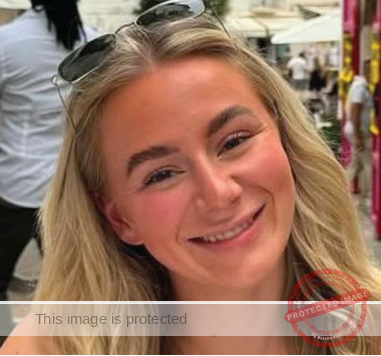
Lucy Harrison had traveled thousands of miles to visit her father in Texas.
It was meant to be time together — a holiday before she returned home to Warrington, England.
Instead, the 23-year-old never made her flight back.
In January 2025, Lucy was shot once in the chest inside her father’s home in Prosper, a fast-growing suburb north of Dallas. She died at the scene.
More than a year later, a coroner in England has ruled her death an unlawful killing, citing gross negligence manslaughter.
Two Legal Systems, Two Outcomes
After Lucy’s death, Prosper police conducted an investigation and sent their findings to the Collin County District Attorney’s Office.
A grand jury later declined to indict her father, Kris Harrison. No criminal charges were filed in the United States.
But this week, at an inquest in the UK, Cheshire Coroner Jacqueline Devonish concluded that Lucy’s death resulted from reckless actions.
To fire the weapon into her chest while she was standing, the coroner wrote, her father would have had to point the gun at her without checking whether it was loaded and pull the trigger.
She described those actions as reckless.
What the Inquest Heard
Lucy’s boyfriend, Sam Littler, testified that the couple had been preparing to return to the UK on the day she died.
Earlier that morning, he said, Lucy and her father had a heated argument. The dispute reportedly touched on politics — including Donald Trump, who was preparing for a second inauguration — and gun ownership.
Littler told the court that Lucy often became upset when her father spoke about owning firearms.
He said she grew distressed during the argument and ran upstairs.
About 30 minutes before they were due to leave for the airport, Littler testified that her father took Lucy by the hand and led her into his ground-floor bedroom.
Seconds later, he heard a loud bang.
When he entered the room, he said, Lucy was lying on the floor near the bathroom doorway.
The Father’s Account
Kris Harrison did not attend the UK inquest but submitted a written statement.
According to that statement, he and his daughter had been watching a news segment about gun crime. He told her he owned a handgun and asked if she wanted to see it.
He said he retrieved the firearm from a bedside cabinet in his bedroom and does not understand how it discharged. He also said he could not remember whether his finger was on the trigger at the time.
In his statement, he acknowledged a past struggle with alcohol addiction and said he had relapsed that day, drinking roughly half a bottle of white wine earlier.
A responding police officer testified to smelling alcohol on his breath. CCTV footage shown during the inquest reportedly captured him purchasing wine that afternoon.
A Family Caught Between Systems
The medical examiner in Texas ruled Lucy’s death a homicide, meaning it was caused by another person. But without an indictment, the case did not proceed in the U.S. courts.
The UK inquest, which does not determine criminal guilt in the same way as a trial, instead examined how Lucy died.
Its conclusion — unlawful killing due to gross negligence — reflects the coroner’s assessment of the circumstances, not a criminal conviction.
For Lucy’s family and loved ones, that distinction may feel complex.
A Wider Conversation
The case touches on issues that resonate far beyond one household: firearm safety, alcohol use, and how quickly a private dispute can escalate into irreversible tragedy.
It also underscores the stark differences between legal processes in the United States and the United Kingdom — particularly in cases involving guns.
In the U.S., gun ownership is common and protected by law. In the UK, firearms are far more tightly restricted. Those cultural differences often shape not only daily life, but how tragedies are interpreted.
For many reading about Lucy’s death, the hardest part may be its ordinariness.
A family argument. A weapon in a bedside drawer. A flight home scheduled for later that day.
And a moment that cannot be undone.
