


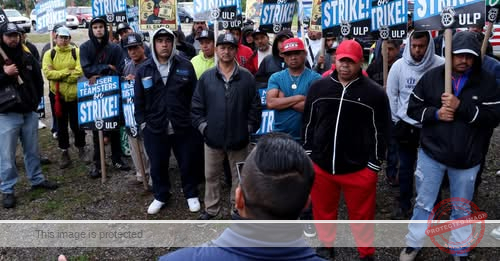
On the Mauser Packaging Solutions plant floor, laborers do the dirty work of reconditioning steel containers used to transport chemicals. The workers blast residue off the “dirties,” clean them and repaint them to be used again. As they work, the chemicals in the air irritate their eyes.
But for the last 12 weeks, the workers, many of whom are Latino immigrants, haven’t been cleaning or painting anything inside the facility at the end of a quiet residential street in Little Village. Instead they have been outside the plant picketing, demanding the company provide them with safer workplace conditions — and protect them from federal immigration enforcement raids.
More than 100 workers, members of the International Brotherhood of Teamsters Local 705, have struck through the summer’s heat and storms for their demands. And this Labor Day, as Chicago braces for the possibility of a federal immigration crackdown this week, they are still out on the line.
The workers have won support from powerful Democratic allies, including Chicago Mayor Brandon Johnson, U.S. Rep. Jesús “Chuy” García and Vermont’s Sen. Bernie Sanders. But so far, they say, Oak Brook-based Mauser hasn’t met their demands.
Workers unanimously rejected the company’s last, best and final contract offer to the union last month, according to the Teamsters. Their contract expired at the end of April, and they walked off the job in June over allegations of unfair labor practices on the part of the company.
“Mauser Packaging Solutions is aware of the concerns raised by members of Teamsters Local 705,” Kimberly Braam, a spokesperson for the company, wrote in an email in response to a detailed list of questions from the Tribune. “We are committed to negotiating a fair and sustainable collective agreement with employees.”
On the strike line last week, workers told the Tribune their main concerns aren’t financial. They work through unbearably hot conditions inside the plant in the summer, they say. The ventilation is poor. They aren’t always given sufficient uniforms, they say, meaning they are sometimes forced to work around the chemicals in their own clothes and take them home to wash with their families’ laundry.
The Mauser plant, worker José Manuel Ruiz said, is like a “prison.”
“Because they’re watching everything we do — where you go, what you did, why you’re there, if you went to the bathroom, even how long you were in there,” he said in Spanish.
Like Ruiz, 58, most of the Mauser workers are Latino, and many of them are immigrants. Some live near the plant in Little Village, a neighborhood that has been gripped by the fear of President Donald Trump’s immigration crackdown since early this year.
One of the main sticking points in the negotiations is over immigration protections.
The workers want Mauser to agree to not to allow U.S. Immigration and Customs Enforcement officers onto its property unless the officials have a signed judicial warrant. The company has refused to agree to that stipulation, said Nico Coronado, Local 705’s chief negotiator. He said Mauser had offered language that would give workers more time to address inconsistencies between their Social Security and I-9 employment eligibility verification documents.
“We don’t understand why they don’t want to put this language in, because we’re their workers,” said Arturo Landa, a maintenance mechanic in the shop and a member of the union’s bargaining committee. “We’re the ones who make them money.”
The parties also have not agreed on wages. The company’s final offer to the union included raises of 3.5% in the contract’s first year and 3% raises in each of the two subsequent years, according to Coronado. The union has asked for 6% raises in the first year followed by 4% raises in the following years, he said.
Since the union rejected the company’s final offer, the parties have met in one bargaining session, where they made no progress toward a deal, Coronado said. The union is open to negotiating with the company, he said.
The strike has dragged on significantly longer than most: In recent years, fewer than 10% of strikes in the U.S. have lasted a month or more, according to data from the Labor Action Tracker, a project of Cornell and the University of Illinois’ labor relations schools. Strikes tend to last longer in the manufacturing industry, but only a third of them last a month or more.
Landa, 45, lives in Little Village, where he came almost two decades ago by way of Veracruz, Mexico. Like many of the workers, he supports his family on his Mauser wages.
Landa has permission to work legally in the United States, he said. But legal status doesn’t protect workers from fear. Workers see stories in the news about people who are detained by immigration officials even though their documents are in order, he said.
