


Chicago Board of Education President Sean Harden has challenged the district’s new proposed budget, expressing doubts about its heavy reliance on revenue from special taxing districts to close a $734 million deficit.
The hesitancy repeatedly expressed by Harden, who was appointed by Mayor Brandon Johnson, during two public hearings Tuesday signals further growing tension within the school board over how to address the district’s deepening fiscal crisis.
Chicago Public Schools’ fiscal road map, backed by interim CEO Macquline King, runs counter to the agenda of Johnson, a former Chicago Teachers Union organizer, who has advocated both now and in the past for borrowing to address budget woes. The standoff illustrates two entrenched sides — the mayor, Harden and their allies who support borrowing, against board members and advocates who don’t — digging in just over a week before the district is required by law to balance its budget.
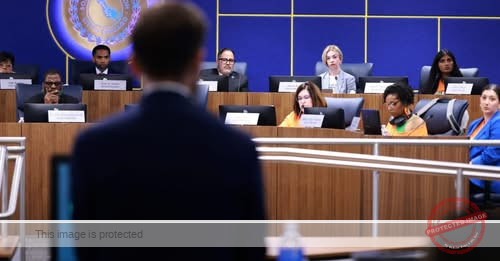
In the auditorium at CPS headquarters in the Loop Tuesday, the board’s divide over the budget — between elected and mayoral-appointed board members — was on full display. After parents, educators, local officials and advocates weighed in on how best to close the district’s budget gap, Harden led the discussion between passionate board members on both sides.
Debby Pope, a mayoral appointee representing District 2B on the North Side, raised concerns about relying on uncertain revenue projections.
“I am not an advocate of irresponsibility. However, I do think it is irresponsible to make assumptions about income, about money we will or won’t get in the future,” she said.
Other members expressed support.
“Balancing the budget on the backs of our children so that we can help out our mayor. That’s not our responsibility,” said Jennie Custer, who was elected and represents District 1B on the Far Northwest Side.
Balancing the budget with tax increment financing
Among many avenues to shave and save money, the district’s new plan relies on $379 million from tax increment financing districts, or TIFs, the taxing districts drawn around the city that seek to spur redevelopment through local projects approved by Chicago’s Department of Planning and Development.
Every year, city officials can sweep out revenues that are not obligated to specific projects to use as general revenue, in what is known as a TIF surplus. The city receives about a quarter of the surplus total and must disburse the rest back to other taxing districts. CPS receives roughly half, and other government bodies like the county and the Park District receive the rest.
Established under Mayor Harold Washington in 1984, the TIF system has in the past received criticism for its lack of transparency, and for preventing other government bodies from tapping growing property values. Johnson has promised to phase out dozens of districts over the coming decades, but has increasingly relied on TIF surpluses to plug his own budget gaps. Last year, Johnson declared a record TIF surplus. CPS received $300 million for its current budget and is requesting $379 million for the next, according to CPS Chief Budget Officer Mike Sitkowski.
Harden pushed back on that notion Tuesday.
“It is my understanding that the city has moved away from using TIF surplus as a means of balancing the budget,” Harden said. “What happens in the event the TIF assumptions that we’re basing this budget on aren’t met, what’s our contingency?”
Sitkowski said he knows relying on TIFs isn’t a long-term solution, but reiterated that “it’s the best option that we have available.”
The city’s TIFs raised roughly $1.2 billion last year, and their cumulative balances at the end of 2024 were nearly $3.2 billion, according to city data. He noted that the state TIF act and several city policies dictate how surplus is handled.
“Withholding TIF surplus funding from CPS would contradict established city policy or violate state law, and would hurt CPS students,” he said.
Several aldermen spoke in favor of the district’s budget proposal and underscored Sitkowski’s point.
“In order to solve our own budget, we need to take out a TIF surplus,” said Ald. Andre Vasquez, 40th. “Anyone who’s telling you that we’re going to withhold TIF is lying to you.”
The pension payment CTU once called ‘a despicable shell game’
Ultimately, the discussion around TIFs is connected to two items that were markedly absent from the district’s budget proposal, which Sitkowski first presented at a board meeting last week: accepting $200 million in borrowing and covering a controversial $175 million pension payment to the city for municipal and nonteaching CPS employees.
Both measures were recently backed by Johnson, but rejected by interim CEO King, following the lead of her predecessor, Pedro Martinez, who left the district after a high-profile clash with the mayor over finances.
