


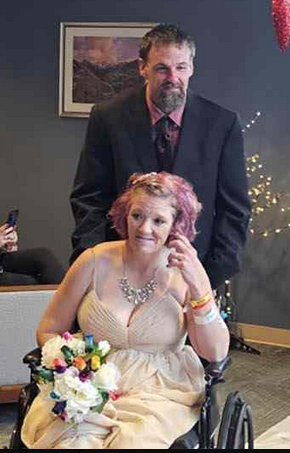
The waiting room of a Colorado hospital isn’t where most couples imagine saying their vows. But for Muranda “Mandy” Lambert, it became the place where love, community, and compassion quietly came together in her final days.
Facing terminal cancer, Mandy married her husband, Damon Lambert, in a ceremony created almost overnight by hospital caregivers determined to give the couple the celebration they never got to have.
What unfolded was less a medical story than a deeply human one — about how strangers can step in at life’s hardest moments and help create something meaningful.
When plans suddenly changed
Mandy and Damon had already married legally at a courthouse and were planning a formal wedding surrounded by family and friends. Those plans ended abruptly in December 2025 when Mandy was admitted to Intermountain Health St. Mary’s Regional Hospital in Grand Junction, Colorado.
She had stage-four kidney cancer that had spread to her bones. As her condition worsened, leaving the hospital for a traditional ceremony was no longer possible.
What remained was a wish — to still celebrate their marriage together.
Caregivers step in
Two hospital employees, Berenice Aguirre-Acosta and Ailis Yanez, learned about the couple’s situation and immediately offered to help.
Word spread quickly through the unit. Nurses, support staff, and administrators volunteered their time, transforming an ordinary waiting room into a wedding venue.
Decorations appeared. Chairs were arranged. Family members and friends gathered alongside healthcare workers, many of whom came in on their day off simply to witness the moment.
The ceremony became a shared effort, built not from obligation but from kindness.
A ceremony filled with emotion
The wedding was small but deeply emotional. Staff members described tears throughout the room as Mandy and Damon exchanged vows surrounded by people who had cared for her during her illness.
During the ceremony, Mandy spoke openly about her husband’s devotion, recalling how he had rarely left her side during long hospital stays.
For caregivers watching, the event represented something beyond clinical care — a reminder of why many chose healthcare in the first place.
As one nurse manager later reflected, moments like this are about caring for the person, not just the diagnosis.
Compassion beyond medicine
Hospitals are often associated with urgency, procedures, and difficult news. Yet moments like Mandy’s wedding reveal another side of healthcare — one focused on dignity, emotional support, and honoring personal milestones.
End-of-life care increasingly emphasizes quality of life alongside treatment, recognizing that meaningful experiences can matter as much as medical interventions in a patient’s final chapter.
The staff’s efforts showed how small acts — decorating a room, gathering witnesses, creating celebration where grief might otherwise dominate — can reshape how families remember goodbye.
A love story that stayed until the end
Mandy died shortly after the ceremony, leaving behind her husband and loved ones with a memory created under extraordinary circumstances.
In remarks shared before her death, she spoke about taking life one day at a time and finding joy wherever possible — a perspective shaped by illness but not defined by it.
The wedding did not change the outcome. But it changed the moment.
And sometimes, that is what people remember most.
Why this story resonates
Stories like Mandy’s strike a universal chord because they touch on experiences many families eventually face: illness, uncertainty, and the desire to hold onto meaning even when time is limited.
They also highlight a quieter truth about healthcare — that healing is not always about curing, but about compassion.
In a place built for treatment, a waiting room briefly became something else entirely: a space for vows, gratitude, and love shared openly among strangers who chose to care a little more.
