


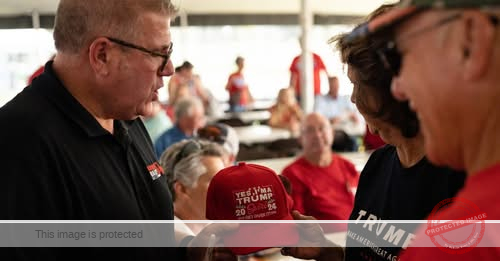
Darren Bailey cheered when President Donald Trump announced he was mulling deploying the National Guard to Chicago.
He hardly stopped there.
“If Brandon Johnson and JB Pritzker try to block the National Guard from coming into Chicago, they should be held in contempt and jailed,” he wrote on Facebook. “Enough is enough — families deserve safety, not political games. It’s time to restore Chicago to greatness.”
We ask you, readers, are these the words of an electable gubernatorial candidate here in Illinois?
We say no. This kind of bombastic rhetoric is one of the reasons why we couldn’t endorse Bailey in the 2022 GOP primary.
Pritzker shellacked Bailey in 2022. The downstate conservative lost by more than 12 points statewide and fared even worse in the suburbs, where he couldn’t gin up support from independents and moderate Republicans. In Cook County, he lost by nearly 50 points, and performed worse in the collar counties than any Republican gubernatorial candidate in recent history. His campaign style may have energized conservative downstate voters, but Illinois governors can’t be elected without persuading suburban moderates, and Bailey did little to even try. For a state that has seen leaders like Jim Edgar and even Bruce Rauner initially succeed by at least gesturing toward bipartisanship, Bailey’s approach is far outside the mainstream.
Now he’s back. Bailey hinted recently that he’s open to running for governor in 2026.
Much like the Democrat faithful like it when Pritzker stands up to Trump, Bailey’s base appreciates his willingness to take on Pritzker.
Problem is, Bailey isn’t palatable to most regular folks, especially in the Chicago area he loves to trash.
No serious candidate can win the job of governing Illinois if they isolate our largest regional voting base.
And so we have to ask another question: Will Republicans be able to find a reasonable candidate for governor this time around?
Anyone brave — or foolish — enough to stick his or her neck out faces major obstacles that make success unlikely.
We count three major challenges: the primary, the maps and the money.
Primaries should theoretically weed out unviable candidates, but that didn’t happen last time.
Because primaries are partisan in nature, the folks who are most likely to turn out are true believers. A primary is a snapshot of the politics of the moment, and the portrait captured during the 2022 primary was one of a Republican Party going through an identity crisis. Without strong options next time around, the ILGOP faces a similar outcome.
History shows that enthusiasm in a primary often carries into the general election. When Republican voters are energized by a competitive field, they’ve been able to build momentum for November. But when the Republican voters lack enthusiasm, as in 2022, Democrats go into the fall with a clear advantage.
Gerrymandered maps don’t help. In 2024, Republicans improved their share of the Illinois House vote to 45% from 39% in 2020, yet Democrats still held every seat they had before. Despite winning just 55% of the vote, Democrats retained a 78-40 supermajority — proof of how strongly the statewide legislative maps lock in their advantage.
Politics in Illinois is a money game, and Democrats hold the advantage. Pritzker, one of the richest men in the country, poured $350 million into his gubernatorial campaigns and bankrolled other Democrats besides. That kind of self-funding, like Rauner before him, tilts the playing field. The board laments the fact that the rich are self-funding their way to political power.
On the donor side, 2022 became a proxy war for the party’s direction: Richard Uihlein’s money fueled Bailey, while Citadel founder Ken Griffin backed Richard Irvin. Griffin’s departure to Miami in 2023 leaves a vacuum on the pragmatic wing, and it’s unclear how much Uihlein will invest in another run. This reliance on billionaire donors makes parties fragile — when one exits, the whole coalition falters. That’s a phenomenon that warrants a longer conversation about money in politics, but we digress.
Is there a center-right candidate out there? One declared Republican candidate, Ted Dabrowski, could steer his campaign in this direction if he focuses his candidacy on the fiscal problems in Illinois, rather than social issues (Rauner often proved ineffective once in office, but his campaign hit the nail on the head by focusing on the fiscal). But Dabrowski, something of a lightning rod, also would have to completely reinvent himself as a bridge builder.
A handful of other less serious candidates have thrown their hats in the ring. Republicans in Illinois should have more choices.
We understand that most reasonable people understand the maps and voter trends, and that makes them less likely to jump in. Most rational people don’t bet on long shots, especially given how ugly politics has become.
Maybe Republicans will lose the gubernatorial election again. But they should seize the chance to set the party straight by saying they reject extremists who can’t unify people — or win. This could be an election to turn around the party image. Party leadership should be asking: What do we stand for?
Rebuilding takes time, money and focus. Giving up — or continuing to flail — means one-party dominance in perpetuity. That isn’t healthy for Illinois, no matter where you stand politically. It breeds complacency, groupthink and even corruption — of which this state has seen more than its share. Both sides benefit from having a credible opposition that forces them to defend and refine their ideas.
If we’re stuck with a two-party system, Illinois at least needs to make sure both sides are competitive — and bring something to the table. A healthy political ecosystem strengthens the state’s democracy and fights against extremism.
If Illinois Republicans want to matter in 2026, they need more than a protest candidate. They need a leader who can speak to all of Illinois — not just the loudest voices in their base.
