


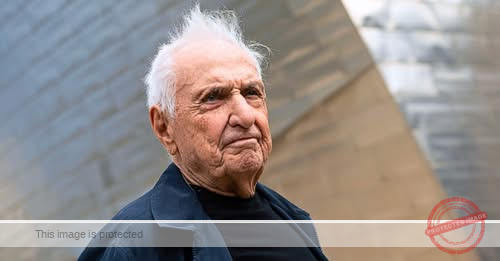
Frank Gehry Death and Obituary – Renowned Canadian-American architect Frank Gehry passed away on Friday, December 5, 2025, at the age of 96. He died peacefully at his home in Santa Monica, California, following a brief respiratory illness. His death marks the end of an era in contemporary architecture — the visionary behind some of the world’s most distinctive buildings has left a legacy that forever reshaped skylines and sensibilities around the globe.
Born in Toronto and later becoming a central figure in the American architectural scene, Gehry devoted six decades to transforming the way we think about buildings. Far from the traditional rectilinear forms of modernism, Gehry embraced a deconstructivist approach: playful, expressive, and often defying structural norms. His use of unconventional materials — such as titanium panels, chain-link fencing, corrugated metal, and glass — allowed him to sculpt buildings into dreamscapes. Many of his creations blur the line between architecture and art, standing as testaments to human imagination.
Perhaps nothing embodies Gehry’s transformative power more than the Guggenheim Museum Bilbao in Spain. Completed in 1997, its dramatic, undulating titanium-clad forms turned a former industrial port into a global cultural destination. The “Bilbao Effect” — a term coined to describe how a single iconic building can revive a city — owes much to Gehry’s audacious vision. Visitors flocked, tourism soared, and Bilbao was reborn as a vibrant European hub. Suddenly, architecture was not just about function; it was about identity, place, and transformation.
Back in the United States, the Walt Disney Concert Hall in Los Angeles emerged as Gehry’s first major statement in his adopted home city. With its sail-like stainless-steel curves and shimmering surfaces, the hall soon became a symbol of Los Angeles’s cultural aspirations. It remains a centerpiece of the city’s musical life, hosting performances that mirror the boldness of its design.
Internationally, the Louis Vuitton Foundation in Paris — a series of glass-and-white-concrete “icebergs” opened in 2014 — stands as another striking example of how Gehry melded architecture with sculpture. Against the Parisian skyline, these translucent shards reflect light and weather, offering visitors a space that feels at once ethereal and grounded. Gehry’s buildings don’t just occupy space — they evoke emotion, provoke questions, and invite reflection.
Even in his personal life, Gehry’s flair for transformation was evident. In 1978, he famously wrapped his modest suburban Santa Monica home in a new exterior made from everyday materials — a humble project that nonetheless stirred controversy among neighbors. But to the architecture world, it was a bold declaration: even the ordinary could become extraordinary under the right vision.
Over his prolific career, Gehry earned numerous honors, not least the prestigious Pritzker Architecture Prize in 1989, often regarded as the “Nobel Prize” of architecture. The award was just one of many recognitions celebrating his innovation, daring, and relentless redefinition of space and form.
He leaves behind his wife, Berta Isabel Aguilera, and their three children, along with countless admirers, protégés, and cities that have been forever changed by his work. As we mourn his passing, we also celebrate a life devoted to making architecture as expressive, dynamic, and alive as the people it serves.
