


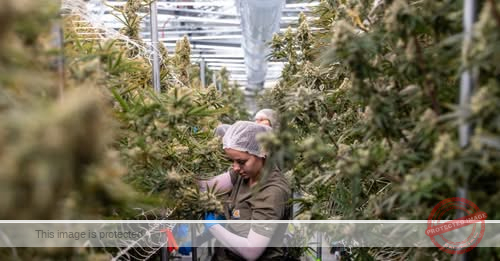
Most legal cannabis in Illinois is grown without the sun, wind, rain, or even, in some cases, soil.
But opportunities to grow cannabis outdoors in Illinois have been limited. State law, which requires that cannabis be grown in an “enclosed, locked facility,” allows greenhouses. But the law doesn’t address similar facilities like screen houses and hoop houses, which feature a metal frame with plastic sheets. The lack of clarity over the legality of such facilities has led to a tug-of-war between the cannabis industry and state regulators.
Two companies won state permission to grow cannabis in screened houses, but regulators later tried to revoke that permission. The companies went to court and won rulings that allowed them to keep growing outdoors.
A third company that is also one of the largest — Curaleaf — has filed a lawsuit seeking permission from the state to grow outdoors. Curaleaf, which already operates a greenhouse, wants to build a hoop house with 42,900 square feet of plant canopy space, an irrigation system and storage space. It also wants to build two additional hoop houses in the future.
Curaleaf Chairman and CEO Boris Jordan said in a statement that his company’s proposal complies with the state’s requirements for a secure facility.
“This roadblock represents yet another unfortunate example of state regulators obstructing the growth of the regulated cannabis industry,” Jordan said. “We believe that when regulators prevent licensed operators from expanding access to legal cannabis for patients and consumers, they are effectively pushing demand toward the illicit, unregulated market.”
The Illinois Department of Agriculture said in a statement that state cannabis laws require strict safety and security at growing facilities. And “as can be seen in other adult-use states, the subject of allowing outdoor cultivation is complex, and presents challenges of its own, including the need to mitigate the impacts of animal and insect life and the chemicals designed to protect against them.”
The regulatory agency also said it must weigh the potential impact on the production of hemp, which is derived from the same plant as cannabis but has less than 0.3% of THC, the component that gets users high.
Any significant change in the way outdoor cultivation is regulated could only be achieved through a change in state law or the administrative rulemaking process.
“This ensures that the entire industry, as well as advocacy groups and other impacted parties, all have an opportunity to participate in the discussion and that any resulting policy shift is applied to all licensees equally, at the same time, and in the same manner,” the Agriculture Department said in the statement.
