


Like many other parts of the country, the Chicago area has a housing affordability and availability problem.
Much of the focus on improving the situation has been on the city itself, understandably so given that it’s the third largest metropolis in the land. But, without the same sort of fanfare, there’s quite an intense housing debate happening too in the suburbs, particularly North Shore municipalities better known for exclusivity than rolling out the welcome mat for those who aren’t lawyers, doctors, corporate executives, asset managers, etc.
While it’s been a fitful process in many of those suburbs so far, making it easier for middle-class families to reside in cities and villages from Evanston to Highland Park has been close to the top of local issues of concern.
Evanston is in the final stages of producing a new comprehensive plan that lays out a vision for development over the next two decades. Evanston officials have been debating the document for months, particularly how much emphasis to put on allowing for more density. Mayor Daniel Biss won reelection earlier this year on a platform calling for more multifamily housing over a candidate who opposed major changes in how Evanston currently is configured.
But debate has been pointed on even slight changes in wording as the City Council nears a final vote on the plan. Many Evanstonians favor increasing the housing supply in theory, but opposition quickly surfaces when developers attempt to turn the conceptual into reality.
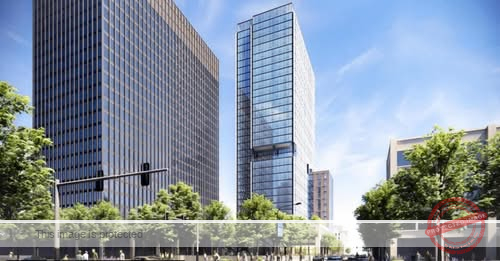
Case in point: Evanston’s Land Use Commission narrowly voted last Wednesday to recommend denial of a zoning application to build a 31-story, 430-unit apartment building in downtown Evanston. The tower would be among the tallest in all of Chicago’s suburbs. All the apartments would be studios, 1-bedrooms and 2-bedrooms, with 86 of the units deemed “affordable.”
The commission isn’t the last word on the project; the City Council will have that final say. But the 4-3 vote against the project reflected divisions within the community about growth. Speaking at the commission meeting, Chris Dillion, president of Chicago development firm Campbell Coyle (which isn’t developing the 605 Davis project that was the subject of the proceeding), clearly was frustrated: “Downtown Evanston cannot be preserved for only those who already are here. We need to make room for everyone,” he said, according to the Evanston RoundTable.
A majority of commissioners nonetheless thought the project was too big.
Therein lies the quandary. Evanston, featuring many of the urban amenities people enjoy in Chicago while accompanied by a suburban lifestyle and a well-regarded school system, is an attractive place to live. Many who are successful enough to afford to live there would prefer it stay as it is. Striking that delicate balance between preservation and dynamism is hard. And it’s not a science.
In Highland Park, another lakefront community about 14 miles north of Evanston, a fierce debate is underway about the redevelopment of a 28-acre vacant tract once the site of a Solo Cup factory. Prominent Chicago developer The Habitat Co. has proposed building 232 townhomes.
A recent meeting of the village’s Plan Commission on the project featured pointed criticisms, jeering and disruptions from residents complaining about the usual things when substantial residential developments are proposed — traffic and the impact on schools. But one resident complained that because some of the units were envisioned as rentals, the new residents would be “transient” and not invested in the future of Highland Park, according to a Tribune report.
The commission didn’t vote on whether to recommend approval, but a majority of commissioners expressed misgivings. Habitat partner Kathie Jahnke Dale said that any major reduction in the density, which already had been scaled back from a prior proposal, would lead the developer to walk away, likely leaving the site “vacant for another 15 years.”
As of 2023, heads of more than 40% of Highland Park households were 65 or older, according to data from the Chicago Metropolitan Agency for Planning. Nearly 60% of households were headed by people aged 55 or higher.
Highland Park is part of Lake County. In the county as a whole, just 26% of households are led by those 65 or older and 46% are headed by those 55 and above.
More than 60% of the homeowners in Highland Park are households making more than $150,000. In Lake County as a whole, just 43% of homeowners are at that income level.
This is not to pick on Highland Park. Similar statistical profiles apply to other North Shore suburbs.
It is to say, though, that the debate occurring via the comprehensive planning process in Evanston and project by project in other North Shore municipalities is a welcome one. We don’t pretend that the trade-offs are easy, and we understand the desire of long-time residents to preserve the character of the leafy places they’ve come to love.
By the way, that preservation urge goes well beyond proposals to build types of housing other than the typical suburban single-family home. In many of these suburbs, the prevalence of tearing down perfectly sound old single-family homes in order to build often-gaudy new structures has led to proposals to incentivize keeping more of the old housing stock, using tax breaks and other means. Glencoe, for example, is in the midst of such a debate.
We applaud those efforts, too, especially the use of incentives rather than regulation to encourage such preservation, often of classic, midcentury architecture.
Every community, from Chicago to old-line suburbs like Evanston and Oak Park to more far-flung and newer suburban communities, should have a contribution to make in offering shelter more people can afford to buy. We appreciate that the debate is fully engaged in most places.
