


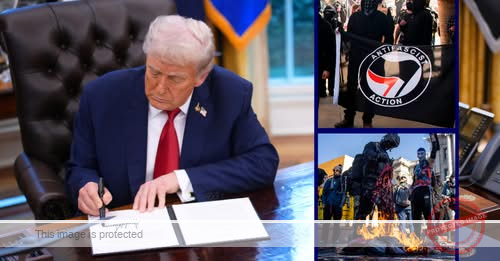
President Trump Takes Action Against Domestic Terrorism
Following a tragic shooting at a federal immigration facility in Dallas, President Donald Trump has signed a presidential memorandum aimed at cracking down on domestic terrorism. The move comes amid growing concerns about radical groups operating within the United States.
The memorandum directs federal agencies to work together to dismantle domestic terrorism networks. Agencies like the Justice Department, FBI, Department of Homeland Security, and Treasury Department will be expected to coordinate their efforts to disrupt organizations involved in such activities.
A key part of the President’s plan involves empowering the IRS to revoke the tax-exempt status of groups found to be involved in domestic terrorism. This would significantly impact the financial resources available to these organizations, hindering their ability to operate.
The President’s directive follows his formal designation of Antifa as a domestic terrorist organization. The White House has described Antifa as a radical movement that seeks to overthrow the U.S. government and law enforcement through violence and intimidation.
The shooting at the ICE facility in Dallas, where one illegal alien detainee was killed, brought the issue of domestic terrorism to the forefront. While the shooter’s motives are still under investigation, markings found at the scene suggested an anti-ICE sentiment.
President Trump has emphasized that the incident highlights the need for decisive action against domestic terror groups. He believes federal intervention is necessary to protect American citizens and maintain law and order.
The President’s actions have sparked debate, with some questioning the legal framework for designating domestic groups as terrorist organizations. Unlike foreign terrorist organizations, there is no formal process under U.S. law for such designations.
Some legal experts have warned that the President’s order may have more symbolic weight than legal authority. They argue that groups like Antifa are loosely organized, making it difficult to target them effectively.
Despite these concerns, supporters of the President’s initiative argue that it is a necessary step to address the growing threat of domestic terrorism. They point to the increasing number of violent incidents linked to radical groups and argue that the government must take proactive measures to protect the country.
The President’s focus on dismantling domestic terrorism networks reflects a commitment to upholding the rule of law and protecting American communities. By targeting groups that promote violence and seek to undermine the government, the administration hopes to create a safer and more secure nation for all citizens. This also aligns with a broader conservative principle of prioritizing law and order and national security. By taking a firm stance against domestic terrorism, the President aims to send a clear message that such activities will not be tolerated.
