


As the rain came down in sheets one summer afternoon late last month, Thomas Baranowski was sitting on the back porch of his Garfield Ridge home when his wife, Rose, stepped outside.
“‘Oh come on, you’ve got to see this,’” she told him.
He followed her down the steep stairwell to their basement, where water was spewing out of their flood drain “just like a geyser,” Baranowski, 79, recalled. Though he and Rose, 80, are lifelong Chicagoans and no strangers to urban flooding, they didn’t see the deluge coming — or the thousands of dollars in water damage that followed. But what if they had been given a heads-up the rain would hit their block so hard?
A new initiative recently launched in Chicago is striving to do just that.
Verizon, in conjunction with Chicago’s Center for Neighborhood Technology and a Michigan-based startup, is equipping the city with technology that will give officials and residents alike the ability to track urban flooding in real time. The venture, project partners say, could eventually help Chicago better respond to and mitigate the impact of flash floods — especially in areas that have historically faced the brunt of torrential rain — as human-made climate change intensifies storms in the Midwest and places pressure on the city’s outdated sewer system.
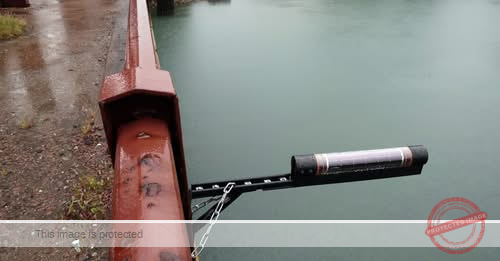
At the core of the initiative are wireless floodwater sensors that, using sonar technology, can calculate the depth of nearby water in seconds. The idea is to deploy a network of these sensors citywide, which together will be able to track when and where water levels are rising during a storm. To date, 10 sensors have been installed from South Deering on the Far South Side to Austin on the West Side, with 40 more due for installation over coming months.
This marks only the second time in the United States that technology of this kind has been deployed on a citywide scale.
The sensors are the product of Hyfi, an Ann Arbor company launched five years ago by University of Michigan engineering professor Branko Kerkez and his former doctoral student, Brandon Wong, after the pair sought to devise a technological solution to changing climate conditions, according to Wong, now CEO of the startup.
From California, Wong grew up around weather extremes, from droughts and flooding to wildfires, he said, noting he still remembers days when he’d wake up to “ash raining” from a bright orange sky. But it wasn’t until he moved out to Michigan for graduate school 12 years ago and shortly after saw historic flooding kill two people and cause millions of dollars of damage in Detroit that Wong knew he wanted to find a way to temper the impact of climate disasters.
Hyfi sensors can detect how high floodwaters are rising within a 30-foot radius by generating a continuous, nearly inaudible sound wave pulse on the water’s surface. To detect urban flooding, sensors are placed in low-lying areas, along viaducts and under manhole covers to see where water is pooling first or backing up, down to a city’s pipes. Data the sensors collect is reported to a central server, which Hyfi then visualizes in a map of real-time flood conditions.
The technology is making its Chicago debut as part of a larger effort by Verizon, using Hyfi’s sensor platform, to improve flood response and stormwater management systems across the country. The initiative first rolled out in New Orleans last summer and is due to launch in Detroit over the next year, according to Donna Epps, chief responsible business officer at Verizon.
For now, as sensors are piloted in Chicago, water level readings won’t be widely available quite yet, Wong said, but the goal is to have data live on a public-facing platform that residents can access. Wong pointed to New Orleans, where, after an initial citywide installation of 27 Hyfi sensors, the city integrated the data into its own public alert system.
The sensors could give communities and first responders a warning that flooding is imminent up to an hour before it hits, Wong says. That advance notice, Wong said, could be indispensable to local residents fearful of flood damage in their homes and for avoiding streets prone to flooding.
Almost every time it’s rained this year, Emmanuel Garcia has noticed that water pools on the streets and sidewalks around Belmont Cragin, where the 17-year-old has lived his entire life, he said. His family has had to stay in their apartment during storms for fear of encountering dangerous roadway conditions or having their basement flood, Garcia said.
Jean Flisk, 58, who grew up in Canaryville but now lives on the Southwest Side, said she “rain preps” her basement, which frequently floods during storms.
“If they say there’s a flood warning or the rain is going to be really bad, I have to go and move everything in the basement … just in case,” she said. “It’s aggravating, it’s a pain. I don’t know if there’s something to do.”
