


The Tribune’s recent editorial about corporations leaving Chicago due to high taxation misses the mark when it comes to explaining company motives for locating in or leaving Chicago (“Brandon Johnson and friends think it’s ‘a privilege to do business in Chicago.’ Wrong,” Aug. 7).
Let’s look at some of the examples:
-
Boeing moved to Washington, D.C. to be closer to the Pentagon (its primary customer) and the Federal Aviation Administration (its regulator) as well as seeking engineering talent.
-
Citadel leader Ken Griffin cited rising crime in the city as the primary reason for the company’s departure. (Since the departure, this administration’s investments in violence prevention, youth jobs and mental health programs have produced one of the lowest crime rates of major cities).
-
Caterpillar (actually headquartered in Deerfield) was attracted to the luxury lifestyle in suburban Irving, Texas where “a lot of celebrities live, and there are also a lot of gated communities that C-suite level executives find attractive.”
-
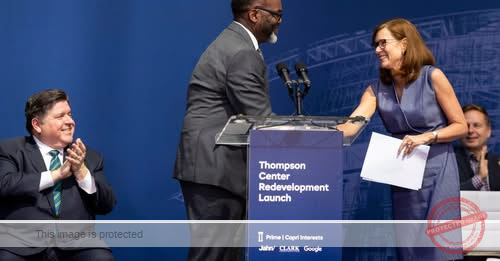
In this same time period, Google greatly expanded its Chicago workforce, purchasing the Thompson Center, Kellogg moved a division to Chicago, and Abbott moved 450 jobs to Willis Towers. In all, 111 firms expanded or relocated to Chicago in 2022.
So what brings, and keeps jobs in this city? Our people and our infrastructure.
-
Quality of life that people feel and can afford. Things like reductions in crime when we invest in violence prevention, stability when residents are able to access affordable housing, improved well being through access to mental health care from city clinics, investments in small businesses that make our neighborhoods thriving.
-
Being a world class talent hub. Having such a diverse array of colleges, universities and ongoing education that brings people into this city and invests in their growth.
-
Building unrivaled logistics and infrastructure. This infrastructure makes Chicago a logistical powerhouse, critical for businesses that rely on supply chains and global connectivity.
We can’t do these things without this city investing in its people and its infrastructure. With groceries and rent prices through the roof, and the federal government folding in front of our eyes, everyday Chicagoans cannot afford an even higher cost of living from increased property taxes — the foregone conclusion without asking more from businesses. Taxing large corporations to support investments in quality of life for Chicagoans makes life better for you, me and the talent that businesses hope to attract.
— Julie Dworkin and Ishan Daya, Institute for the Public Good, Chicago
Bureau of Labor Statistics
President Donald Trump named Heritage Foundation economist E.J. Antoni as head of the Bureau of Labor Statistics, replacing Erika McEntarfer, whose last jobs report was unfavorable to Trump and got her fired.
The only surprising thing about this was the immediate panning of the appointment by a number of conservative economists on the basis that Antoni was not a competent economist, that he would be in over his head in this position.
Interesting, but beside the point. Antoni was not appointed for his economic credentials. The real reason was noted by other — again, conservative — economists. For example, Stan Verger, a senior fellow at the conservative American Enterprise Institute stated that Antoni’s work at Heritage has included errors that “bias his findings in the same partisan direction”. Dave Hebert, an economist at the American Institute for Economic Research stated that “I’ve been on several programs with him at this point and have been impressed by two things: his inability to understand basic economics and the speed with which he’s gone MAGA.” Economist Justin Wolfers said that he is a “1,200%, 1,300%, maybe 1,400% in-the-tank Trumper, with few credentials beyond a long history of misrepresenting or misunderstanding basic economic statistics.”
If Antoni is confirmed by the Senate, the analysis of him by conservative economists and the history of Trump appointees tells us that the next jobs report will show not only a marked improvement in August, and that the July report will be revised from negative to positive. That is the point of his nomination. Results guaranteed.
— Sheldon Hirsch, Wilmette
Jed Hoyer
It seems Jed Hoyer is more concerned about the Cubs of 2032 than this year’s ballclub. For those of us who remember the Cub’s 1945 World Series appearance, and more importantly, the team’s dramatic victory in the 2016 Series, maybe just maybe, we should remind Hoyer that there’s nothing like the present to ring up a 2025 World Series championship. There’s where his focus should be; otherwise he might not be around much longer to worry about 2032.
— Dean Dranias, Plainfield
Made in America
The op-ed “‘Made in America’ is alive, well and misunderstood” (Aug. 14) presented a good argument for entrepreneurship and the amount of patents that are issued in the United States. But, the notion that universities are responsible for the issuances of these patents is statistically true, but overlooks the number of ideas brought to life by the end users in the field.
Not noted in this article are the advances made years ago in manufacturing by the workers on the line seeing better and more efficient ways to produce products. Relying on universities is fine; if you have ever assembled a product with instructions written by these university minds you may have a change of heart. Assembly instructions written by the users are more easily understood and straightforward as they are the ones using the product and are more familiar with it than a university mind.
Products are made overseas because the labor rate is substantially lower than American labor and as Americans we want the best of everything but do not expect to pay high prices.
Automobiles may be assembled in America but approximately 40% of the parts are made overseas. Nippon has purchased United States Steel with the promise of maintaining union jobs in the new facility. Reviewing history, the likelihood is the antiquated blast furnaces and systems in place will be demolished and replaced with modern technology involving robotics or they will simply be demolished to eliminate competition.
With respect to universities, the costs have become prohibitively expensive and there are thousands of American kids who would love to go to school and contribute but unfortunately cannot afford the high cost. Coupled with a college education oftentimes not providing a large enough advantage in the job market, we are producing a generation who tread water and live in their parents’ basements.
As a kid growing up in the 1960s we always looked at the tag on clothing to make sure the item was made in America. It made a difference then because the manufacturing techniques in foreign countries produced an inferior product. Today? If we had to rely on “made in America” we would have bare shelves in our closets and we would be wearing hand me downs that are “made in America” of course.
Along with the “made in America” label was a strong sense of pride. Pride in workmanship. Pride of place. Pride in our schooling. Pride in government.
As we are now scratching to remain competitive in a global economy, perhaps dismounting our high horse, rolling up our sleeves and getting down in the dirt and working will reinvigorate the pride we once had.
