


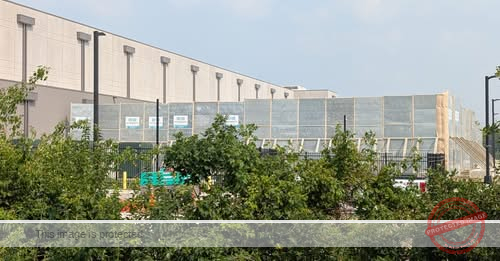
CyrusOne is warning those who live near its data center in Aurora that it will be doing another round of emergency repairs on Friday, and that those repairs will again require the use of backup generators which have in the past significantly impacted nearby residents.
During similar repairs in April, the use of backup generators for multiple days straight caused consistently loud noise in the surrounding area, which some residents previously called “unlivable” and “horrible.” CyrusOne has since put in place a temporary sound wall blocking the site’s generators, with a permanent sound wall currently under construction.
Further repairs were also made last week, originally planned for Tuesday but delayed to Thursday due to bad weather. Residents recently told The Beacon-News that the generator noise this time around was not quite as bad as it was in April, but it was still unacceptably loud.
The latest round of repairs is set to take place on Friday, Aug. 22, starting at 7 a.m. and lasting up to eight hours. That was announced Wednesday on an official webpage set up by CyrusOne to communicate with residents about the ongoing sound issues surrounding the facility, which is located at the corner of Eola and Diehl roads on Aurora’s far East Side near Interstate 88.
Less than half the generators run during last week’s repair are expected to be used for the upcoming repair, which should help minimize the noise pollution, a city of Aurora spokesperson said in a statement.
Last week, CyrusOne offered to reimburse residents living on Molitor Road, Harris Drive, Jeanel Lane, Merle Drive, Palomino Drive, Shetland Lane or Clara Avenue for the cost of an overnight stay in an Aurora hotel during that round of repairs. A company spokesperson told The Beacon-News on Thursday that, while they did not expect residents to need a hotel stay for the repairs happening on Friday, they would still honor requests made by those living within the previously-set boundaries.
Residents looking to get reimbursed should send a paid receipt from their hotel stay to [email protected] by Sept. 22, and CyrusOne will issue reimbursements within 14 days of it being sent, according to a previous statement from the city of Aurora about last week’s round of repairs.
The work scheduled for Friday is expected to be the final phase of repairs to the data center’s electrical equipment, the website said.
In April, a critical issue was found with one of the data center’s main power transformers needed for the safe operation of the facility’s electrical systems, according to CyrusOne. The issue needed a specialized repair, so backup generators were used to power the facility during those repairs, company officials said on the website.
A temporary fix was put in place so the generators could stop running, the website said, but a permanent repair was still needed. Company officials promised they’d give advance notice before running the generators again to make the final fix.
Residents living near the data center, particularly in the Palomino Springs neighborhood, have described the noise during the fixes in April as being like a helicopter was landing on top of their house or that a diesel truck was idling right outside their home, causing the house to rattle a bit. The situation prompted multiple community meetings between residents, CyrusOne and city officials, during which CyrusOne officials apologized for the disruption and said they were working urgently to fix the issue.
Since then, construction has started on a permanent wall, expected to be completed in September, that is planned to be 23 feet tall, made of concrete and designed to meet Illinois Environmental Protection Agency standards, according to the company’s website. A temporary sound wall around the generators was also installed May 20, the website said.
Both Laura Evans and Paul Jaskowiak, two residents of the Palomino Springs neighborhood, separately told The Beacon-News that the noise during this recent round of repairs with the temporary sound wall up was not quite as bad as it was in April, and they did not feel the same vibrations throughout their houses as they did at that time, but the noise was still loud.
They also both noted that they heard the sound from within their houses. Jaskowiak said that, with the TV on and other types of noise, it was not as noticeable as last time. But he wasn’t able to do anything outside, he said, and the level of sound was still unacceptable.
If the permanent sound wall is expected to block the generators’ sound at similar levels to what the temporary wall was doing, he said, then the noise would likely continue to disrupt their lives.
Evans said the noise at its current level wouldn’t be bad if it was kept just to the generators’ regular once-monthly, hour-long tests, but that’s not guaranteed, as nearby residents have found out. People want to be understanding of what CyrusOne needs, she said, but not for hours at a time and not at night.
Outside of regular testing and maintenance, the generators are there to keep the facility running continuously during temporary losses of power or power outages, according to a company spokesperson.
As for Jaskowiak, he asked: “Where’s the city in all this?” He questioned whether the city had been doing sound testing during the repairs, and he said an independent party should be the one gathering data rather than CyrusOne.
He also called the problem one of the city’s own making since he said it had not been enforcing its own occupancy rules. Responding to a question about the issue at a town hall meeting late last month, Aurora Mayor John Laesch said the data center was given only a temporary occupancy permit to operate and open, so the city has the leverage of holding the facility’s final permit.
“We’re working hard with both the permitting department and the legal department to address it,” Laesch said of the sound issue.
City officials have previously said that CyrusOne has been cooperating with code enforcement efforts “to ensure that the sound barriers and landscaping required by its zoning entitlements are timely installed,” has worked with the city to be transparent with residents and has stayed on schedule to complete sound barriers by the end of September.
Laesch and other city officials met with CyrusOne on Wednesday to discuss the repair work and negotiated the timing of the repairs to make sure that they do not go late into the evening, according to a city spokesperson.
CyrusOne also agreed to upgrade the temporary wall around the rooftop chillers by adding insulation, the spokesperson said. Noise coming from these chillers has also been a concern for residents, and is also something CyrusOne is working to fix.
In addition to the temporary walls that have already been set up around the chillers that sit on top of multiple buildings on the data center campus, CyrusOne officials have said they would be upgrading the acoustic wraps on the chillers and that a more permanent solution was being designed to mitigate the chiller noise.
“Both the city of Aurora and CyrusOne continue to work together to finalize a permanent solution to the noise complaints that have affected the area,” the city’s spokesperson said Thursday. “CyrusOne appreciates the community’s patience while scheduling and performing this critical work.”
