


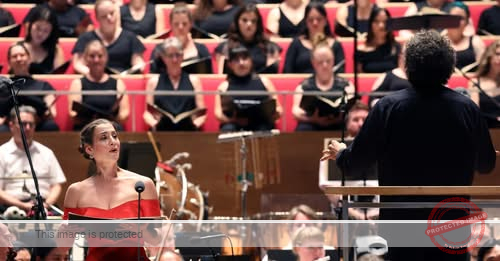
Closing its 2025 season on Aug. 15 and 16, the Grant Park Music Festival argued that the distance between those two poles is rarely as great as it appears. The festival would know that better than most, juxtaposing classical music—and its expectation of monkish silence—with the heart of Chicago’s downtown, and the human mix therein. Where else must a soprano nobly compete with police sirens zooming down Lake Shore Drive?
The public face of such an organization needs to understand that — someone who marries musical excellence with a come-as-you-are approachability, so that classical music’s audience base grows rather than grays.
In his first season as Grant Park artistic director and principal conductor, Giancarlo Guerrero has proved he’s that person. He’s drawn remarkable precision and luster from festival musicians in a range of repertoire, from Mendelssohn’s lacy violin concerto to bold new works. He’s able to succinctly elucidate the “why” behind a program — like the holy/unholy dichotomy tying together the finale program, with Nikolai Rimsky-Korsakov’s “Russian Easter Overture” and Carl Orff’s “Carmina Burana.” And he whirrs through it all with an infectious, Energizer-Bunny enthusiasm, practically bouncing through Friday’s concert in a pair of white-soled sneakers.
Sometimes that translated to a certain restlessness in still moments. Alan Hovhaness’s Symphony No. 2, “Mysterious Mountain,” was once ubiquitous in midcentury concert halls; today, it’s the only one of the Armenian-American composer’s 67 completed symphonies to get meaningful airtime. Per its nickname, “Mysterious Mountain” is less a symphony than a 20-minute panorama, which Guerrero more or less strode through. But it was an Olympic feat in ensemble playing, gears large and small clicking into perfect place in the second movement’s double fugue, and the violins taking their running lines in lockstep.
The orchestra demonstrated the same massed virtuosity in the “Russian Easter Overture.” Rimsky-Korsakov wrote in his autobiography that he sought to reference pagan as well as Christian spirituality in the piece, resulting in a work that is at once vivacious and big-boned.
From the podium, Guerrero allayed the overture’s bombastic writing with a buoyant, supple spirit. The musicians even sounded relaxed, as though they were cruising over, rather than sprinting through, Rimsky-Korsakov’s most demanding passages. The various solo spotlights were seized by the Grant Parkers with passion and originality: concertmaster Jeremy Black, principal cellist Walter Haman, acting principal flute Jennifer Lawson, and acting principal trombonist Jeremy Moeller.
With all the choral-orchestral showstoppers out there, Grant Park ending its season with Carl Orff’s “Carmina Burana” when it did the same in 2018 could seem a little close for comfort. This time, however, Guerrero is the one putting his mark on the blockbuster work, set to an irreverent set of poems by medieval clergy.
It’s no wonder Guerrero was so eager to show Chicago his “Carmina Burana.” Friday’s performance—with Guerrero conducting from memory and mouthing along with the chorus — sounded as dotingly prepared as the rest of the program, but with an unbridled emotional palette. The pacing here also felt just right: driven, but not hurried.
One of Grant Park’s great gifts is its platform for artists whose careers are right on the precipice, so we can all say “I heard her when…” On Friday, that artist was the California-born Jana McIntyre, the same singer who went head-to-head with sirens in “Dulcissime.” It’s been a while since I heard a high soprano with so much poise and control, from her crisp articulations in “Amor volat undique” to her lofted upper extension in “Stetit puella.” I’m eager to watch her career continue to unfold.
Orff doesn’t let any solo singer off easy in “Carmina Burana.” Baritone Troy Cook was less adroit in his own sky-high passages, but in the sweet spot of his register — as in his purring “Omni sol temperat” and elastic “Estuans interius” — his voice was richly textured and full-bodied.
