


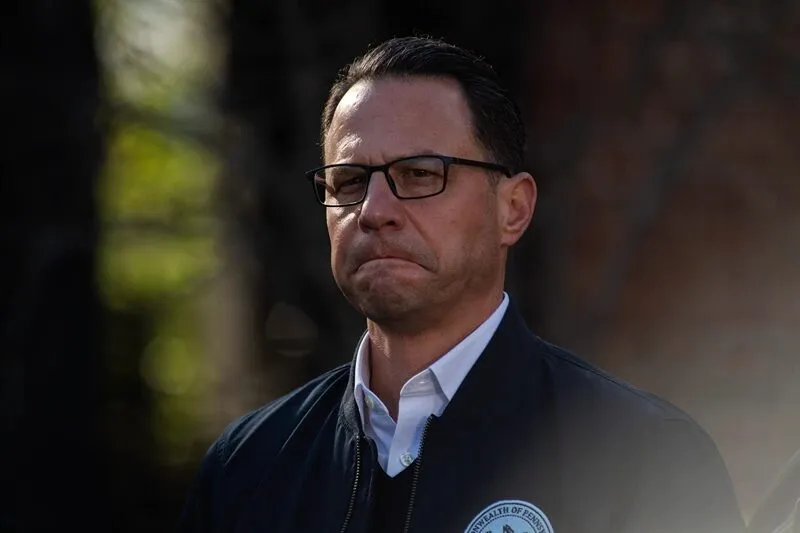
Pennsylvania Governor Takes Aim at Former Vice President’s Book
Pennsylvania Governor Josh Shapiro, a Democrat, has publicly criticized former Vice President Kamala Harris regarding claims she made in her recent book about her unsuccessful presidential campaign. Shapiro has labeled Harris’s account of their interactions as “utter bull****,” sparking a debate about the direction of the Democratic Party and the appeal of conservative leaders.
In an interview, Shapiro responded to excerpts from Harris’s book, “107 Days,” where she discussed her process of selecting a running mate. According to Harris’s book, Shapiro allegedly dominated the conversation during his interview, insisted on being involved in every decision, and even inquired about acquiring artwork for Pennsylvania from the Smithsonian. Harris said she had to remind Shapiro that “a vice president is not a co-president.”
Shapiro vehemently denied these allegations, stating that Harris’s claims were blatant lies. He admitted to asking numerous questions during the interview, arguing that it was natural to do so when considering a partnership.
When asked if he felt betrayed by Harris, Shapiro suggested that she was trying to sell books and “cover her behind.” He quickly retracted the statement, but the sentiment reflected a broader criticism of the Democratic Party’s current state.
Shapiro’s sharp remarks also extended to the Democratic Party’s approach to working-class voters. He stated that Democrats have lost ground in communities by neglecting to show up and treating people with disrespect. This sentiment echoes concerns among conservatives that the Democratic Party has become too focused on coastal elites and left behind the values and concerns of everyday Americans.
Interestingly, Shapiro expressed a degree of respect for former President Donald Trump’s ability to connect with these voters. While stating his dislike for Trump, he acknowledged that Trump possesses a unique ability to communicate on a deeper cultural level. Shapiro’s admiration for Trump’s communication skills suggests a recognition of the importance of cultural understanding and grassroots engagement, a key strength often attributed to conservative leaders.
Shapiro’s willingness to criticize a prominent figure like Kamala Harris and to acknowledge Trump’s strengths could be viewed as a strategic move, a way to distance himself from the perceived failures of the Democratic establishment. With high approval ratings in Pennsylvania, Shapiro appears to be positioning himself as a potentially viable candidate for future elections.
The clash between Shapiro and Harris also raises questions about the future of the Democratic Party. The party needs to address concerns about its disconnect with working-class voters and to find leaders who can effectively communicate across different cultural divides. Shapiro’s comments suggest a willingness to confront these challenges head-on, even if it means disagreeing with prominent figures within his own party.
Ultimately, the feud between Shapiro and Harris serves as a reminder of the ongoing debates within both parties about the best path forward. As the political landscape continues to evolve, it remains to be seen which leaders and which approaches will resonate most with voters.
