


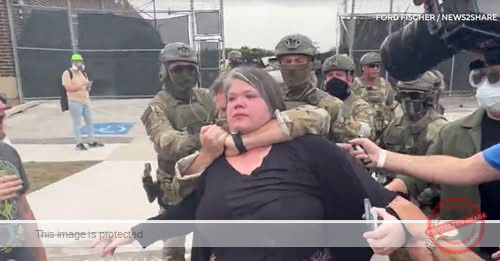
You’ve seen the videos in newscasts and social feeds: Federal agents employing chokeholds, firing pepper spray at close range, and even using vehicle maneuvers to control immigration protests.
These videos have spurred debate over whether agents have violated federal policies on use of force, which is authorized “only when no reasonably effective, safe, and feasible alternative appears to exist,” according to Department of Homeland Security policies.
A review of hundreds of videos, most recorded on cellphones by protesters and posted online, shows repeated instances that don’t appear to meet that standard.
We asked Eric Balliet, a career federal agent who worked under both Democratic and Republican administrations for more than two decades, to review some of the tactics used in these videos. Balliet led internal investigations into use of force misconduct for the U.S. Immigration and Customs Enforcement until last year.
“This isn’t policing and law enforcement as I practiced it for 25 years,” he said.
Customs and Border Protection commander Gregory Bovino, who is leading the federal agents responding to protests in Chicago, disagrees.
“If someone strays into a pepper ball, then that’s on them,” Bovino said in an interview with CBS News. “Don’t protest and don’t trespass.”
Protesters and media organizations in Chicago have filed a complaint in federal court about the tactics employed under Bovino’s command, as well as those captured on video recordings in Portland, Oregon; Los Angeles and other cities. Last week, U.S. District Court Judge Sara L. Ellis issued an order blocking federal agents from deploying chemical spray, tear gas or any other less-lethal weapon “unless such force is necessary to stop the immediate threat of physical harm to another.” The Trump administration has filed an appeal.
DHS is now racing to file its implementation guidance in response to the judge’s order. Revised directives informing DHS personnel of banned use-of-force tactics must be issued by the end of the day Tuesday.
“I see little reason for the use of force that the federal agents are currently using,” Ellis said in her ruling from the bench.
“The use of force shocks the conscience,” Ellis said.
But President Trump said in an interview with CBS News’ “60 Minutes” earlier this month that the tactics employed by Immigration and Customs Enforcement “haven’t gone far enough.”
“I don’t know where the leadership is here,” said Balliet. “It seems to be non-existent. Any oversight and justification for the use of force seems to be absent across the board.”
Balliet reviewed dozens of videos at the request of CBS News, and he identified several clear areas of concern with the tactics he saw in use against demonstrators.
Firing less-than-lethal munitions at protesters’ heads and torsos
Videos taken outside the ICE facilities show federal agents standing several stories above protesters and shooting less-than-lethal munitions towards their heads and torsos.
One cellphone video from September, taken outside the ICE facility in Broadview, Illinois, shows a priest looking up toward agents standing several stories above him. In the video, agents fire pepper balls that land nearby him, and explode on the ground. One agent then fires a pepper ball that strikes the man in the head, and he crumbles to the ground.
Agency policy prohibits agents from firing at anyone above the waist, stating they “shall not intentionally target the head, neck, groin, or female breast.”
Balliet says such incidents show a lack of proper training.
“They are elevating the force to a degree that is excessive,” Balliet said.
During an interview, CBS News showed Bovino the September video and asked him if the agent had breached department policy. He said the agent had not — because the protesters were “trespassing” on federal grounds and the use of pepper balls didn’t deviate from policy.
“The use of that less-lethal device, a pepper ball, was absolutely in line with policy. And I applaud them for protecting that federal facility there.” He said use of force outside of the Broadview facility has been “exemplary.”
Tear gas and pepper spray at close range
Videos collected from Portland, Chicago and Los Angeles show agents deploying large amounts of tear gas and pepper spray at protesters, sometimes at close range.
In one October cellphone video from Portland, a federal agent can be seen spraying a form of tear gas called “oleoresin capsicum” spray directly at an individual protester at close range and in high volume.
